

What are the clamping - force control methods for the Multifaceted Integrated Stacking Machine?
As a supplier of Multifaceted Integrated Stacking Machines, I understand the critical role that clamping - force control plays in the performance and efficiency of these machines. In this blog, I will explore various clamping - force control methods for Multifaceted Integrated Stacking Machines, providing in - depth insights into their principles, advantages, and applications.
1. Hydraulic Clamping - Force Control
Hydraulic systems are widely used in Multifaceted Integrated Stacking Machines for clamping - force control. The basic principle of hydraulic clamping is based on Pascal's law, which states that pressure applied to an enclosed fluid is transmitted undiminished to every portion of the fluid and the walls of the containing vessel.
In a hydraulic clamping system for a Multifaceted Integrated Stacking Machine, a hydraulic pump generates pressure, which is then transferred to hydraulic cylinders. These cylinders are responsible for applying the clamping force to hold the workpieces in place during the stacking process.
One of the main advantages of hydraulic clamping - force control is its ability to provide high clamping forces. Hydraulic systems can generate large forces with relatively small components, making them suitable for heavy - duty applications. Additionally, hydraulic systems offer precise control over the clamping force. By adjusting the pressure in the hydraulic circuit, operators can accurately set the desired clamping force according to the requirements of the stacking operation.
However, hydraulic systems also have some limitations. They require regular maintenance to prevent leaks and ensure proper functioning. The hydraulic fluid needs to be changed periodically, and the system may be sensitive to temperature changes, which can affect the performance of the clamping force.

2. Pneumatic Clamping - Force Control
Pneumatic clamping - force control is another popular method used in Multifaceted Integrated Stacking Machines. Pneumatic systems use compressed air to generate the clamping force. The basic components of a pneumatic clamping system include an air compressor, valves, and pneumatic cylinders.
When the air compressor supplies compressed air to the pneumatic cylinders, the cylinders extend or retract, applying the clamping force to the workpieces. Pneumatic clamping systems are known for their simplicity and cost - effectiveness. They are relatively easy to install and maintain, and the initial investment is usually lower compared to hydraulic systems.
Pneumatic clamping also offers fast response times. The compressed air can quickly actuate the cylinders, allowing for rapid clamping and un - clamping operations. This is particularly beneficial in high - speed stacking applications where quick cycle times are required.
On the downside, pneumatic systems typically provide lower clamping forces compared to hydraulic systems. They are more suitable for light - to medium - duty applications. Additionally, the performance of pneumatic systems can be affected by air leaks, which may lead to inconsistent clamping forces.
3. Mechanical Clamping - Force Control
Mechanical clamping - force control methods rely on mechanical components such as screws, levers, and springs to apply and maintain the clamping force. For example, a screw - type clamping mechanism uses the rotation of a screw to tighten a clamp, applying pressure to the workpiece.
Mechanical clamping systems are often simple and reliable. They do not require external power sources such as hydraulic pumps or air compressors, which can reduce the overall complexity and cost of the machine. Mechanical clamps are also relatively easy to operate and maintain.
However, mechanical clamping may have limitations in terms of the adjustability of the clamping force. Once the clamp is tightened, it can be difficult to make fine - tuned adjustments to the force. In addition, mechanical clamps may be subject to wear and tear over time, which can affect their performance.
4. Electromagnetic Clamping - Force Control
Electromagnetic clamping - force control uses the magnetic field generated by an electromagnet to hold the workpieces in place. When an electric current is passed through the electromagnet, it creates a magnetic field that attracts the ferromagnetic workpieces.
One of the significant advantages of electromagnetic clamping is its non - contact nature. This means that there is no physical contact between the clamping device and the workpiece, which can reduce the risk of damage to the workpiece surface. Electromagnetic clamping also offers fast and precise control. The clamping force can be easily adjusted by changing the current flowing through the electromagnet.
However, electromagnetic clamping is mainly suitable for ferromagnetic materials. It may not be effective for non - ferromagnetic materials. Additionally, the electromagnetic clamping system requires a reliable power supply, and any power outage can result in the loss of the clamping force.
5. Application Considerations
When choosing a clamping - force control method for a Multifaceted Integrated Stacking Machine, several factors need to be considered.
- Workpiece Material and Size: Different materials and sizes of workpieces may require different clamping forces. For example, larger and heavier workpieces may need higher clamping forces, which may be better achieved with hydraulic or electromagnetic clamping.
- Stacking Speed: High - speed stacking operations may require clamping systems with fast response times, such as pneumatic or electromagnetic clamping.
- Accuracy Requirements: If high precision is required in the stacking process, a clamping system that offers precise force control, such as hydraulic or electromagnetic clamping, may be more suitable.
6. Our Product Range and Clamping - Force Control
As a supplier of Multifaceted Integrated Stacking Machines, we offer a wide range of products with different clamping - force control methods to meet the diverse needs of our customers.
Our Semi - automatic Chemical Mechanical Polishing Machine is equipped with advanced clamping - force control systems to ensure stable and accurate polishing operations. The clamping force can be precisely adjusted according to the requirements of different workpieces.
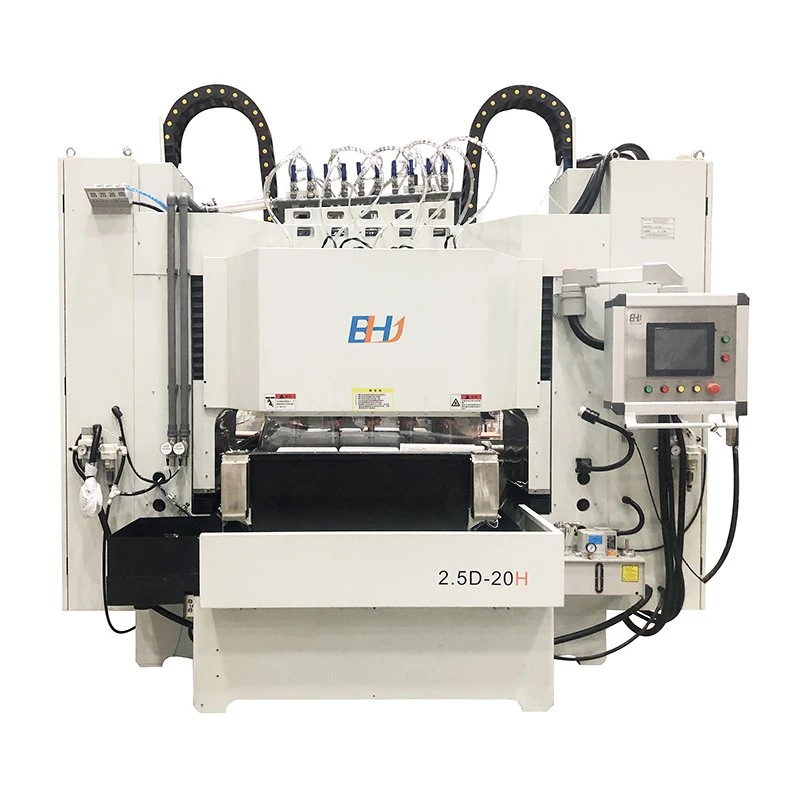
Our 3D Multi - station Automatic High - speed Polishing Machine and 2.5D Multi - station Automatic High - speed Polishing Machine also feature reliable clamping - force control mechanisms. These machines are designed for high - speed and high - precision stacking and polishing, and the clamping systems are optimized to provide consistent and efficient performance.
7. Contact for Purchase and Negotiation
If you are interested in our Multifaceted Integrated Stacking Machines or have any questions about clamping - force control methods, we encourage you to contact us. Our team of experts is ready to provide you with detailed information, technical support, and customized solutions. Whether you are looking for a machine for a small - scale production or a large - scale industrial application, we can offer the right product for you.
References
- "Industrial Automation Handbook", John Wiley & Sons
- "Hydraulic and Pneumatic Systems: Design and Application", McGraw - Hill Education
- "Mechanical Engineering Design", Pearson Education